
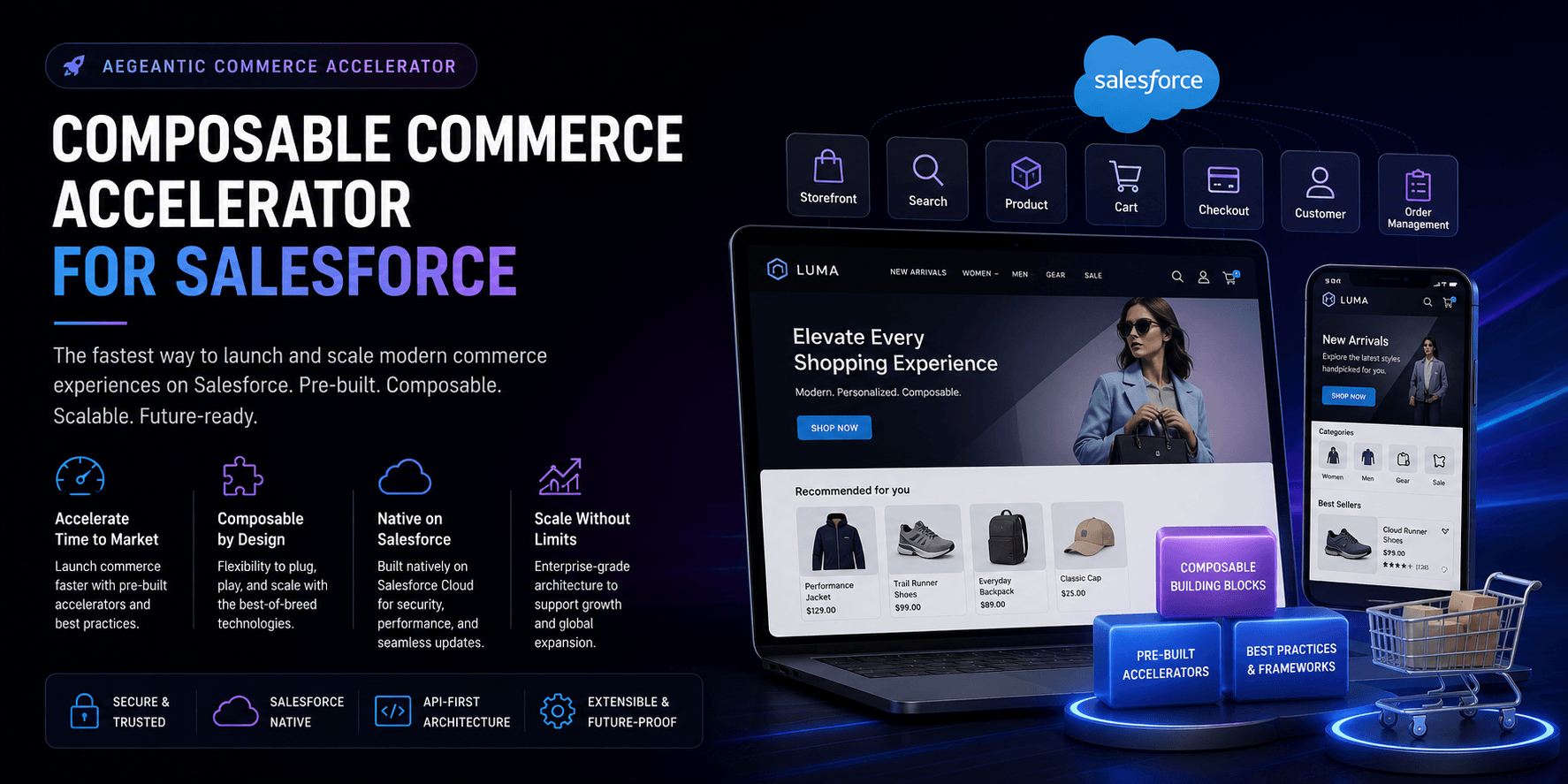
Composable Commerce Accelerator for Salesforce
Transform your Salesforce Commerce into a high-performance composable powerhouse — delivered in weeks, not months.
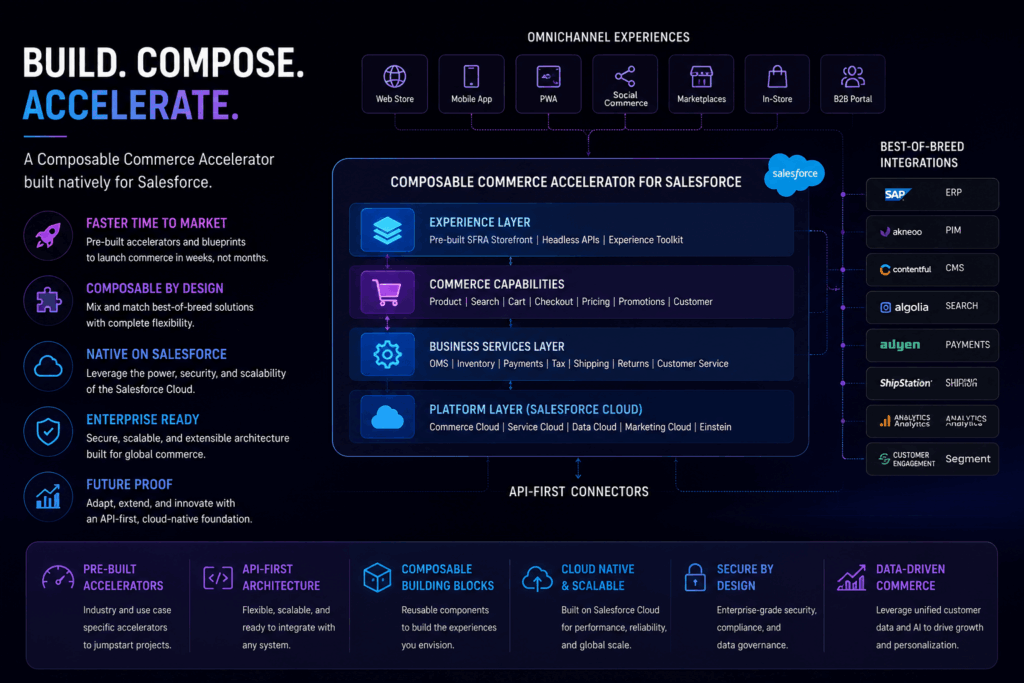
Launch Headless Commerce. Faster. Smarter. Scalable
FeatureMind’s Composable PWA Accelerator is a production-ready, enterprise-grade storefront framework built on Salesforce PWA Kit and SCAPI.
It enables brands to move to a composable, API-first architecture with up to 70% faster delivery and significantly reduced engineering effort — without compromising performance, scalability, or customer experience.
Whether you are:
- Launching a new Salesforce Commerce Cloud storefront
- Migrating from SFRA or SiteGenesis
- Expanding into multi-country or multi-brand commerce
- Decomposing an existing monolithic architecture
Our accelerator provides a proven, modular foundation to accelerate your transformation.
Built on Modern Salesforce Architecture
Our accelerator is built on:
- Frontend: Salesforce PWA Kit (React + Node.js)
- Backend: Salesforce Commerce Cloud (SCAPI & Custom APIs)
- Hosting Options: Salesforce Managed Runtime or Cloudflare Pages
- Architecture: API-first, decoupled, composable
This architecture delivers:
- Lightning-fast performance
- Server-side rendering (SSR)
- Mobile-first experience
- Offline-friendly capabilities
- Full UI/UX flexibility
- Seamless third-party integrations
What Makes Our Accelerator Different?
This is not a boilerplate template.
It is a battle-tested framework developed across real-world enterprise headless commerce projects.
We built it while delivering global Salesforce programs — identifying recurring needs and transforming them into reusable, production-ready modules.
The result:
A scalable foundation ready for enterprise commerce from day one.
Core Capabilities
Localization & Geolocation
- Automatic IP-based region detection
- Site, currency, and language auto-assignment
- Manual locale switcher
- Multi-country & multi-brand support
- RTL support
Perfect for global commerce expansion strategies.
CMS Integration
Supports:
- Salesforce Page Designer
- Contentful
- Contentstack
Includes:
- 35+ prebuilt CMS component types
- Hundreds of layout variations
- Dynamic rendering
- Banners, video blocks, carousels
- Reusable content modules
Advanced Search Experience
- Real-time suggestions
- “Did you mean” logic
- Smart filtering & sorting
- Personalized results
- Custom no-result screens
Optimized for conversion.
Modular Cart & Checkout
- Guest & logged-in cart
- Cart merging upon login
- Shipping method logic
- Coupon validation
- Locale-aware checkout flows
- Conditional payment visibility
Built for complex business rules.
Enterprise Payment Integrations
Pre-integrated with:
- Adyen
- PayPal
- Checkout.com
- Amazon Payment Services
- Klarna
- Tabby
- Tamara
- Apple Pay, Google Pay, COD
Dynamic visibility by:
- Country
- Currency
- Order amount
- Customer type
Wishlist & Customer Account
- Wishlist management
- Address book
- Order history
- Registration & authentication flows
- Password reset
- Move items between wishlist & cart
Fully customizable per locale.
Engagement & Conversion Boosters
Back In Stock
- Subscribe to out-of-stock products
- Variant-level support (size, color)
- Email/SMS notifications
- Guest & logged-in users
- Fully localized
Reduces lost revenue when inventory runs out.
Abandoned Cart Recovery
- Tracks guest & logged-in carts
- Configurable delay timers
- Dynamic cart content in emails
- Marketing automation integrations
Works with:
- Salesforce Marketing Cloud
- Insider
- Proven revenue recovery driver.
Extensive Store Locator
- Interactive map with geolocation
- Distance-based sorting
- Click & Collect filtering
- CMS-managed store details
- Google / Apple Maps integration
- Mobile-first UX
Bridges digital and physical retail.
Third-Party Integrations
Pre-abstracted integrations include:
- Google Tag Manager
- Gameball
- Salesforce Einstein
- Journify
- Dynamic Yield
- Bazaarvoice
All integrations are abstracted — new vendors can be added without impacting core logic.
Built-In CI/CD & DevOps
- GitHub Actions workflows
- Cloudflare deployment pipelines
- Environment switching (Dev / Stage / Prod)
- Automated linting & testing
- Slack / Teams notifications
Faster releases. Fewer errors. Greater scalability.
Business Impact
Speed to Market
Up to 70% faster delivery
Pre-tested reusable components
Reduced QA cycles
Faster developer onboarding
Cost Efficiency
~60% reduction in engineering hours
Less repetitive development
Faster ROI realization
Strategic Flexibility
Multi-site & multi-brand ready
Cloud-native architecture
Easy extension without vendor lock-in
Continuous deployment support
Why Aegeantic?
Our leadership and core experts have been part of the Salesforce ecosystem since 2013 and have delivered complex Salesforce Commerce implementations across North America, Europe, and Asia.
We transitioned to a direct-to-enterprise model to deliver high-impact, composable commerce programs with elite Salesforce talent.
Our accelerator reflects years of real-world delivery expertise — not theoretical architecture.
Ready to Accelerate Your Composable Commerce Journey?
Whether you’re launching new markets or modernizing your current storefront, our Composable PWA Accelerator provides a scalable, high-performance foundation for growth.
Let’s build your next-generation commerce experience.
Contact us to schedule a technical walkthrough or architecture session.
Everything You Need to Know Before Moving to Composable Commerce
01 Does using the accelerator limit our architectural flexibility?
No. The accelerator is designed to increase flexibility, not restrict it.
It follows a fully decoupled, API-first approach using Salesforce PWA Kit. All integrations are abstracted, meaning:
You can replace vendors.
You can introduce new services.
You can evolve toward microservices.
You can adopt additional composable tools over time.
There is no vendor lock-in at the frontend layer.
02 How does this support long-term scalability?
The architecture is built for:
High traffic volumes
Cloud-native deployments
Independent frontend/backend scaling
Multi-region rollout strategies
Because the storefront consumes APIs rather than relying on server-side templates, scaling can be handled independently across infrastructure layers.
03 What governance model do you recommend for enterprise clients?
We typically recommend:
A structured branching strategy (main / staging / release)
Automated CI/CD pipelines
Dedicated feature environments
Clear component ownership
API versioning strategy
The accelerator already includes deployment workflows compatible with Salesforce Managed Runtime and Cloudflare Pages, supporting enterprise-grade governance.
04 How does the accelerator handle security?
Security is handled across multiple layers:
Secure SCAPI authentication
Token-based session handling
Environment-based configuration isolation
No exposure of sensitive credentials in frontend code
Compliance-ready architecture
Security best practices are embedded into the framework structure.
05 Can we gradually transition to composable commerce instead of a full rebuild?
Yes.
A phased migration approach is possible, including:
Running composable storefronts for selected markets
Migrating specific pages (e.g., PDP first)
Launching a new brand headlessly
Maintaining legacy storefront during transition
This reduces operational risk and allows controlled modernization.
06 How does this impact marketing agility?
Marketing teams benefit from:
Faster campaign launches
Flexible CMS-driven content blocks
Easier integration of personalization tools
Faster A/B testing enablement
Because frontend deployments are independent, marketing changes do not require full backend release cycles.
07 What KPIs typically improve after moving to this architecture?
While results vary by business, organizations typically observe improvements in:
Page load performance
Mobile conversion rates
Checkout completion rates
Deployment frequency
Time-to-market for new features
Composable architecture enables experimentation and continuous optimization.
08 Is this aligned with Salesforce’s future roadmap?
Yes.
The accelerator is aligned with Salesforce’s headless strategy centered around SCAPI and modern storefront development principles. It is built to evolve alongside Salesforce’s API-first ecosystem.