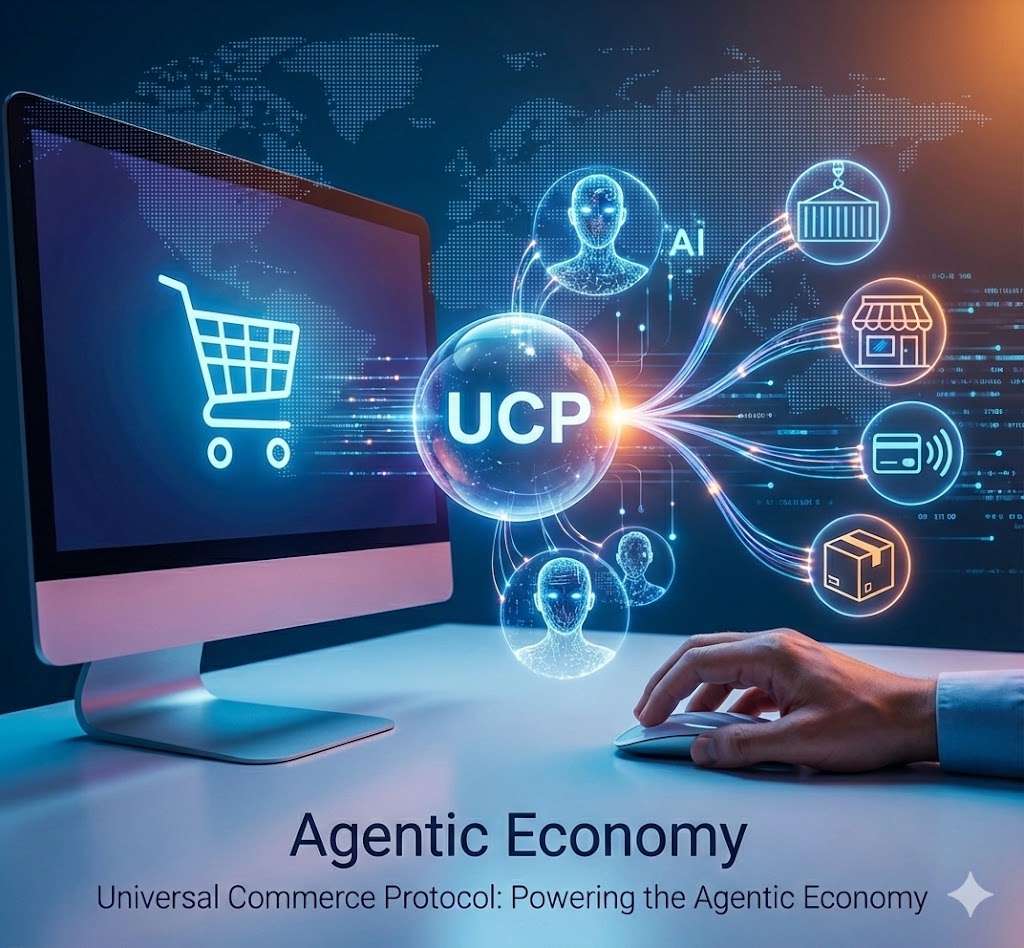
For the last two decades, e-commerce has followed a predictable pattern: a human searches for a product, visits a website, scrolls through a catalog, adds an item to a cart, and manually checks out.
That era is ending.
We are entering the age of Agentic Commerce—where AI agents don’t just find products for you; they negotiate, order, and pay for them. The infrastructure making this possible is the Universal Commerce Protocol (UCP).
In this post, we’ll break down what UCP is, look under the technical hood, and explore how it will rewire global trade.
What is the Universal Commerce Protocol (UCP)?
The Universal Commerce Protocol (UCP) is a new open standard (spearheaded by Google in collaboration with industry giants like Shopify, Walmart, and Target) designed to standardize how AI agents interact with commerce systems.
Think of it as “HTTP for Shopping.” Just as HTTP allows any browser to talk to any server, UCP allows any AI agent (like Gemini, ChatGPT, or a specialized travel bot) to talk to any merchant’s backend.
Before UCP, if an AI wanted to buy shoes for you, it had to “read” a website like a human (web scraping), which is slow, brittle, and error-prone. With UCP, the AI and the store speak a common machine-readable language.
Under the Hood: Technical Details
For the developers and tech-savvy merchants reading this, UCP isn’t a platform or a marketplace. It is a set of specifications that define Capabilities, Extensions, and Transports.
1. The Modular Architecture
UCP breaks the shopping journey into standardized “Capabilities” that a merchant can expose via API:
- Discovery: The agent queries the merchant’s catalog (structured feeds, not HTML).
- Cart Management: The agent can add/remove items and apply discount codes programmatically.
- Checkout: A standardized flow for shipping, taxes, and final transaction execution.
2. Transports and Interoperability
Flexibility is the core feature of UCP. It supports multiple “transports” (ways to move data), ensuring it fits into existing tech stacks:
- REST APIs: Standard HTTP requests for traditional integrations.
- Model Context Protocol (MCP): Anthropic’s standard for connecting AI models to data. UCP can be “bound” to MCP, allowing LLMs to natively understand a store’s inventory.
- Agent2Agent (A2A): Enabling direct communication between a user’s personal AI and a brand’s sales AI.
3. Security and The “Merchant of Record”
One of the biggest technical hurdles in agentic commerce is trust. Who holds the credit card? Who handles the data?
- Tokenized Payments: UCP separates the payment instrument (the user’s wallet) from the payment handler (the processor). This allows agents to pass secure, tokenized payment credentials without ever seeing the raw credit card number.
- Merchant of Record: Crucially, UCP ensures the merchant remains the “Merchant of Record.” The transaction happens directly between the buyer and the seller, not through a middleman aggregator.
The Impact on Global Commerce
Why does this matter? Because it fundamentally shifts the economics of the internet.
1. From SEO to “Feed Engineering”
In a UCP world, you aren’t optimizing your store for human eyeballs; you are optimizing it for AI logic. “Keywords” matter less than structured data hygiene. If your UCP profile doesn’t explicitly state [material_origin: recycled], the eco-conscious AI agent will simply ignore your product. The new SEO is Feed Engineering.
2. The Death of the “Session”
Global commerce analytics rely on “sessions” and “click-through rates.” UCP kills this. An AI might buy a product via an API call without a single page view occurring on your website. Brands will need to shift their KPIs from traffic volume to API intent volume and conversion efficiency.
3. Democratization vs. Centralization
UCP could democratize commerce by allowing a small boutique in Turkey to be just as accessible to a global AI agent as Amazon is. As long as the boutique speaks “UCP,” the agent can find and buy from them. However, it also risks centralizing power in the hands of the interface providers (the companies building the AI agents), who become the new gatekeepers of demand.
The Universal Commerce Protocol is more than just a tech update; it is the foundation for a machine-to-machine economy. For merchants, the message is clear: the next billion customers won’t be visiting your website—they’ll be sending their agents.
Are your APIs ready to answer?
Phase 1: Foundation & Data Hygiene (The “Feed Engineering” Phase)
Before writing code, ensure your data is structured for AI consumption.
-
[ ] Audit Product Data Schema:
-
Ensure all products have Global Trade Item Numbers (GTIN/ISBN) where applicable.
-
Verify attributes are explicit (e.g., use
material: "100% Cotton"instead of burying it in the description). -
Action: Validate your feed against the Google Merchant Center Product Data Specification.
-
-
[ ] Implement Real-Time Inventory Sync:
-
AI agents need millisecond-accurate stock levels to prevent “hallucinated” availability.
-
Action: Upgrade batch updates to webhooks or event-driven architecture for inventory changes.
-
-
[ ] Standardize Pricing Logic:
-
Ensure complex tier-pricing or bundle discounts are accessible via API, not just front-end JavaScript logic.
-
Action: Centralize pricing rules in a backend service that an API can query.
-
Phase 2: The UCP Core Integration
Connecting your backend to the Universal Commerce Protocol.
-
[ ] Publish the UCP Manifest:
-
Create a JSON file at
https://yourdomain.com/.well-known/ucp. -
Required Fields: Define your supported Capabilities (e.g.,
discovery,cart,checkout) and Extensions (e.g.,loyalty_program). -
Action: Use the [UCP Schema Validator] to ensure your manifest is syntactically correct.
-
-
[ ] Build the “Discovery” Endpoint:
-
Create an endpoint that allows an agent to query your catalog without scraping.
-
Output: Structured JSON returning product details, variants, and real-time pricing.
-
-
[ ] Implement the “Cart” Capability:
-
POST /cart/create: Allow an agent to initialize a session.
-
POST /cart/update: Allow adding/removing items via simple API calls (no cookies required).
-
Action: Ensure the API returns a stable
cart_idthat the agent can persist.
-
Phase 3: Payments & Trust
Handling the transaction securely while remaining the Merchant of Record.
-
[ ] Integrate Tokenized Payments:
-
Update your payment gateway to accept Payment Tokens (not raw credit card numbers).
-
Action: Verify compatibility with Google Pay / Apple Pay token standards.
-
-
[ ] Implement “Guest Checkout” via API:
-
Agents often act as “guests” initially. Ensure your checkout API doesn’t force a user account creation step before payment.
-
-
[ ] Security Handshake:
-
Implement signature verification to validate that incoming requests are from authorized agents (e.g., verified Google or OpenAI signers).
-
Phase 4: Testing & Verification
Simulating an AI agent’s behavior.
-
[ ] Run the “Happy Path” Simulation:
-
Script a sequence: Search -> Add to Cart -> Calculate Tax -> Submit Payment Token -> Receive Order Confirmation.
-
-
[ ] Test Error States:
-
What happens if an item goes out of stock during the agent’s negotiation? Ensure the API returns a structured error code (e.g.,
409 Conflict), not a generic HTML 404 page.
-
-
[ ] Load Testing:
-
Agents operate faster than humans. Ensure your API rate limits are adjusted for high-speed machine interactions.
-
Phase 5: Advanced (Optional)
-
[ ] Bind to Model Context Protocol (MCP):
-
If running your own LLM support, bind your UCP endpoints to an MCP server so your internal AI can read your own live data.
-
-
[ ] Agent2Agent (A2A) Setup:
-
Define protocols for “handing off” a complex human customer service query from a shopping bot to your human support team.
-
“Don’t build this from scratch if you don’t have to.” If you are on Shopify, BigCommerce, or Salesforce Commerce Cloud, check their roadmaps. They are likely building “UCP Adaptors” that will do 80% of this work for you. This checklist is primarily for Headless Commerce architectures and custom builds.